
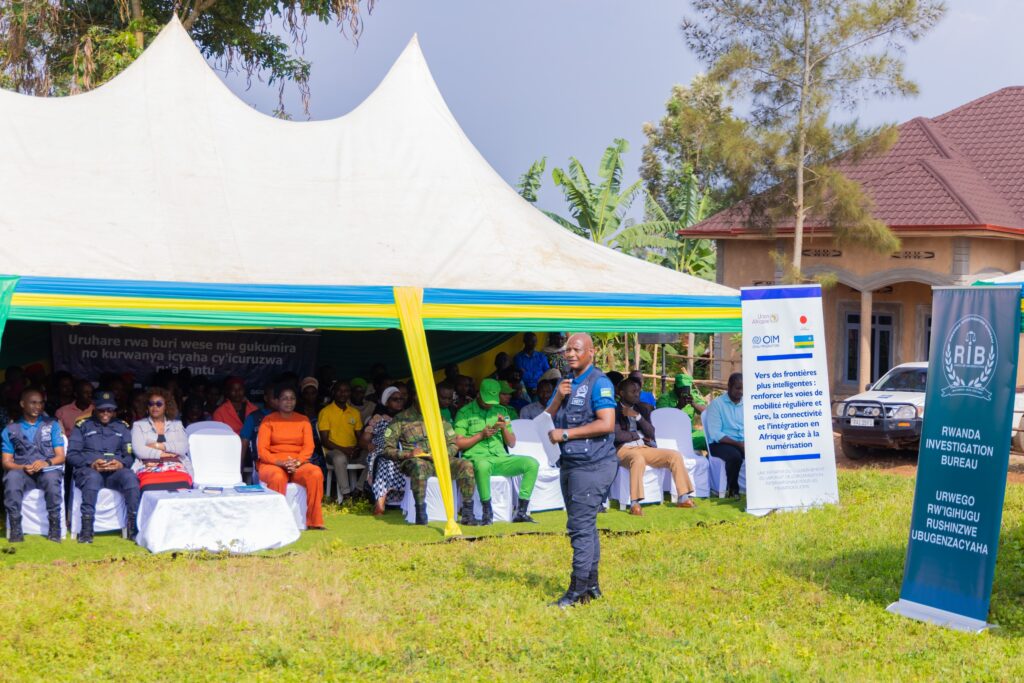
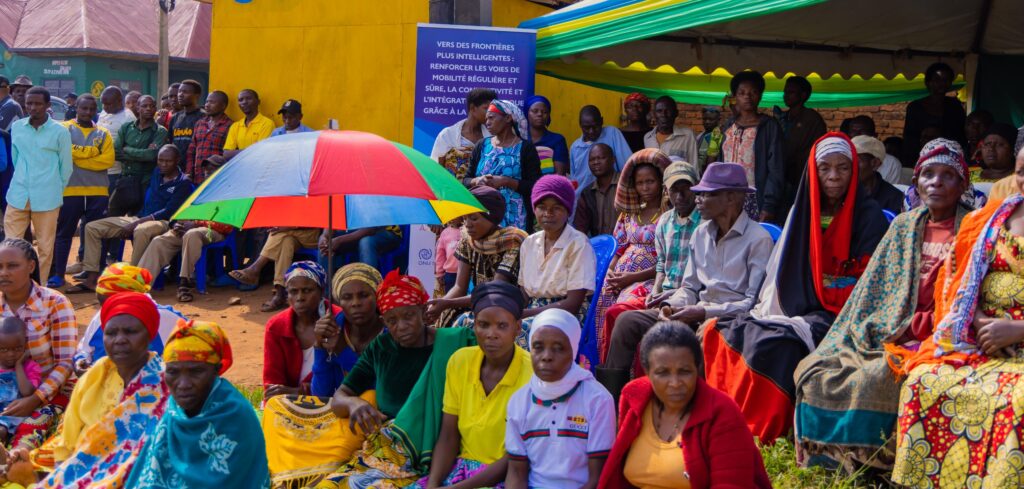
Residents of border sectors in Rusizi district have been called upon to remain vigilant and actively participate in the fight against human trafficking, a crime authorities say is increasingly targeting vulnerable communities near national frontiers.
The awareness campaign was conducted through a partnership between the Rwanda Investigation Bureau (RIB), the International Organization for Migration (IOM), and the Embassy of Japan in Rwanda. During an outreach session held in Rwimbogo Sector, residents were educated on the nature of human trafficking, the tactics used by traffickers, and the importance of exercising caution, especially when promised lucrative jobs abroad.
According to RIB, human trafficking cases are more prevalent in border areas than in inland regions, which explains why the nationwide campaign is prioritizing sectors located along Rwanda’s borders.
Jean Claude Ntirenganya, an official in charge of combating crime at RIB, said traffickers often exploit border crossings to move their victims.
“Most trafficking cases involve victims being transported through border points. That is why we are engaging communities living near these borders so they understand the reality of this crime and recognize that they are some perpetrators around. Their cooperation is crucial in combating human trafficking,” he said.
To illustrate the dangers and deceptive methods used in trafficking, residents were presented with testimony from a survivor who was lured through Facebook by an individual who promised her a job opportunity in Kenya. Instead, she found herself trafficked to the Middle East.
“One day, a girl asked me why i was silently enduring the challenges i was facing. She told me she had found me a job in Kenya. Within three days, she said everything was arranged. I told her i had no money for a ticket or a passport, but she covered all the expenses. I travelled believing she would receive me in Kenya, but someone else picked me up and took me to a house where other girls and women were living like prisoners,” she recounted.
She was later informed that the promised job in Kenya no longer existed and that she would instead be sent to Asia. “At that moment, I had already become like property. Even at the airport, I was processed like merchandise,” she said.
The survivor was eventually taken to Kuwait, where her travel documents were confiscated and her name changed before being placed in a household where she was to work under harsh conditions. She was later rescued and repatriated to Rwanda.
Ntirenganya warned that human trafficking has evolved and is now carried out using increasingly sophisticated methods. He noted that young people are being deceived with promises of education or employment abroad, only to end up exploited in terrorist networks, cybercrime operations, forced prostitution, or even organ trafficking.
“A child leaves home promised a good job or quality education, only to find themselves trapped in criminal activities. Some are subjected to organ harvesting. They are treated like animals, kidneys removed and sold, livers extracted and traded. These cases are real,” he emphasized.
RIB reminded the public that involvement in human trafficking-related activities is a serious criminal offense under Rwandan law. Individuals convicted of trafficking committed within the country face prison sentences ranging from 10 to 15 years and fines of between 10 and 15 million Rwandan francs. In cases involving cross-border trafficking, penalties increase to 20 to 25 years in prison and fines ranging from 20 to 25 million Rwandan francs.
Authorities are urging communities, particularly those in border areas, to report suspicious activities and remain alert to protect themselves and others from falling victim to traffickers.




One thought on “Rusizi: border communities urged to prevent and combat human trafficking”
It’s really important work being done there. Supporting these border communities is key to tackling this issue effectively.